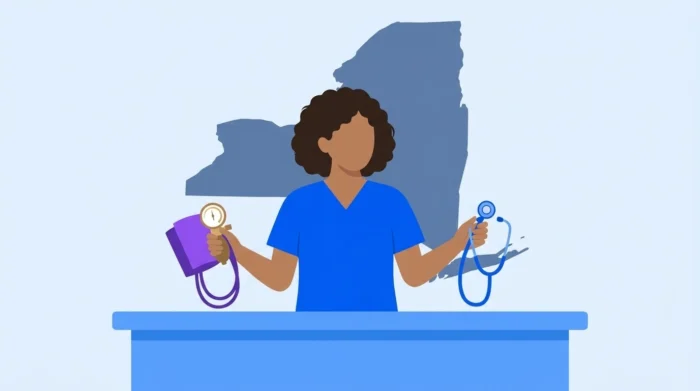

New York doesn’t require a state license to work as a medical assistant, and it doesn’t require a certification from a national organization either. Legally, you can be hired without both.
But most employers want more than that. In the National Healthcareer Association’s (NHA) 2025 Industry Outlook, 96% of employers said they require or encourage certification. And to sit for a certification exam like the CCMA (NHA), you need a high school diploma or GED.
So becoming a medical assistant in New York comes down to 4 steps: finish school, pick the right program, do an externship and pass a certification exam. Below you’ll find each step in the process, what the job pays, and why medical assistants in New York can’t give shots, even with training.
The 4 steps to becoming a medical assistant in New York
1. Finish high school or earn a GED
You need a high school diploma or GED to sit for the CCMA (NHA) exam. If you’re still in high school or working on your GED, you can apply as long as you finish it within the next 18 months.
2. Pick a program, and check which certification it makes you eligible for
This part is important, so read it carefully.
If you’re going through a training program, the program you enroll in decides which certification exams you can sit for. You don’t want to find that out after you’ve paid.
So get 2 numbers out of any school before you pay: total instruction hours and total externship hours, which is supervised time working with patients in a real clinic. Some certifying bodies set minimums for both.
For the CMA (AAMA), accreditation matters too.
CAAHEP (the Commission on Accreditation of Allied Health Education Programs) and ABHES (the Accrediting Bureau of Health Education Schools) accredit medical assisting programs, and that program-level accreditation is separate from a school’s institutional accreditation.
Read the last column first, because it decides which programs are open to you.
| Credential | Issued by | What you need to qualify |
| CCMA (NHA) | National Healthcareer Association | A training program from an accredited or state-recognized provider, finished in the last 5 years. Or 1 year of supervised medical assisting work in the last 3 years (or 2 in the last 5). |
| CMA (AAMA) | American Association of Medical Assistants | A CAAHEP- or ABHES-accredited program. Or the Alternative Pathway, a program at an accredited school with 560 academic hours over the equivalent of 2 semesters, plus a 160-hour externship (or 1,000 hours of work afterward). AAMA also has routes for past CMAs and educators. |
| RMA (AMT) | American Medical Technologists | A program at an accredited school with 720 hours, including a 160-hour externship, finished in the last 4 years. Or an AMT-approved 500-hour course with a 160-hour externship and a skills check. Or 3 years of full-time work in the last 7, covering both clinical and administrative duties. AMT also has military and instructor routes. |
Fees differ too. The CCMA (NHA) exam costs $169. The CMA (AAMA) costs $125 for AAMA members and for students and recent graduates of CAAHEP or ABHES programs, and $250 for other nonmembers. AMT charges $150 to apply for the RMA.
Springboard’s Certified Medical Assistant program prepares you for the CCMA (NHA). Its coursework runs 4 months online, and enrollment includes an exam voucher, which covers the CCMA exam fee.
3. Do the externship
This is where you work with patients in a real healthcare setting, under supervision. Here’s how to get a medical assistant externship.
Hours vary by program. Hunter Business School on Long Island, for example, requires 190 hours.
The CMA (AAMA) Alternative Pathway asks for 160 (or 1,000 hours of work afterward), and the RMA (AMT) program route asks for 160.
For the CCMA (NHA), the NHA asks that you complete a training program (or have qualifying work experience), so your program sets the externship hours. Springboard’s CCMA externship, for example, generally runs 80 to 150 clinical hours.
Programs handle externship placement differently. Some coordinate your externship through healthcare organizations they work with, while others ask you to find your own externship site. Ask which one you’re getting.
Springboard supports both routes, depending on what’s available in your area.
Sites set their own requirements, commonly a background check, immunizations and CPR certification.
4. Take the exam, then start applying
Once you’ve finished your program, you apply for the exam and pick a date. For the CCMA (NHA), you can test at your school, at a PSI testing center or online with a live proctor. NHA posts online exam results to your account within 2 days of scoring.
Then start applying. If your externship went well, tell that clinic you’re looking for a job, and maybe they might hire you. Otherwise, use and highlight the credentials you’ve gained to secure a job as a medical assistant.
What a medical assistant is allowed to do in New York
In Texas, a doctor can delegate medical tasks, including giving injections, to a “qualified and properly trained person” they supervise (Texas Occupations Code ch. 157). In New York, a medical assistant can’t give shots, however well trained.
That’s because New York’s education department (NYSED) keeps a list of what medical assistants can and can’t do. A doctor who has you do something on the “can’t” side commits professional misconduct under Education Law §6530(11).
| You can | You can’t |
| Take vital signs, like blood pressure | Decide which patients are seen first |
| Run ECGs (heart rhythm tests) | Give vaccines |
| Draw blood, if trained, in a “CLIA-waived” office (one certified to run only simple lab tests) | Give shots or medications of any kind |
| Collect lab samples, like urine or throat swabs | Fill a syringe with medication |
| Run basic hearing and vision tests | Take x-rays |
| Change bandages | Put in stitches, or put on or remove casts |
| Take out stitches and staples, supervised by a licensed professional who checks the patient first | Put in or remove IVs or catheters |
| Enter history, medications and allergies into the chart | Tell patients about positive test results |
So the tasks NYSED lists as allowed are in the left column: vitals, blood draws, heart tests and charts. Shots, vaccines and medications go to licensed staff, like a nurse or doctor.
The list doesn’t cover every task. If something isn’t on it, ask whether it takes a medical decision. If it does, it isn’t yours to do.
A certification won’t add anything to the list, either. It helps you get hired, not do more once you’re there.
What medical assistants earn in New York
New York pays medical assistants better than the country as a whole. The statewide median is $23.08 an hour (BLS, May 2025), against $21.97 nationally, and the NYC area is higher still.
The median is the middle wage across everyone in the job, not just new hires. The lower end pays better here too. A quarter of New York medical assistants earn less than $20.96 an hour, compared with $18.50 nationally.
| Area | 25th percentile, hourly | Median, hourly | Median, annual |
| New York State | $20.96 | $23.08 | $48,000 |
| New York-Newark-Jersey City metro (includes parts of New Jersey) | $22.11 | $23.26 | $48,370 |
| Albany-Schenectady-Troy | $18.56 | $21.57 | $44,870 |
| Buffalo-Cheektowaga | $18.47 | $21.47 | $44,650 |
| Rochester | $18.88 | $20.05 | $41,710 |
| Syracuse | $18.23 | $21.27 | $44,250 |
| United States | $18.50 | $21.97 | $45,690 |
Wages for medical assistants. Source: U.S. Bureau of Labor Statistics, Occupational Employment and Wage Statistics, May 2025 release, occupation 31-9092.
BLS counted 40,710 medical assistants working in the state in May 2025. Nationally, it projects employment of medical assistants to grow 13% from 2025 to 2035 (BLS Occupational Outlook Handbook).
Where medical assisting can take you
Medical assisting can also be a first step toward better-paid healthcare roles, and some of them typically start with a certificate program.
| Role | New York median, hourly | Typical training |
| Phlebotomist | $24.29 | Certificate program |
| Medical records specialist | $29.67 | Certificate program |
| Licensed practical nurse (LPN) | $32.30 | Certificate program, plus a state license |
| Surgical technologist | $38.25 | Certificate or associate degree |
| Registered nurse (RN) | $52.62 | Bachelor’s degree, plus a state license |
| Physician assistant (PA) | $77.35 | Master’s degree, plus a state license |
| Medical and health services manager | $78.90 | Bachelor’s degree |
Source: U.S. Bureau of Labor Statistics, Occupational Employment and Wage Statistics, May 2025, New York State. Training is the typical entry-level education in the BLS Occupational Outlook Handbook.
What New York programs cost, and what to compare
Here’s how 2 New York programs stack up against Springboard’s online program.
| Program | Length | Cost the school lists | Certification it prepares you for |
| Hunter Business School diploma | 7½ months (days) or 15 months (evenings) | $16,392, supplies included | CMA (AAMA) |
| Queensborough Community College CCMA program | 2 semesters | $5,265 | CCMA (NHA) |
| Springboard’s Certified Medical Assistant program | 4 months online, then an externship | $2,638 with early registration, exam voucher included | CCMA (NHA) |
Hunter’s diploma costs the most, but it’s CAAHEP-accredited, which is the direct route to the CMA (AAMA).
Springboard’s is the lowest price and the shortest timeline of the 3. It prepares you for the CCMA through a partnership with the NHA, and the coursework is online at about 15 hours a week, so you can fit it around a job.
It also helps with what comes after the coursework. You get support with your externship placement, and career coaching continues for up to 6 months after the curriculum ends, or until you start a new job.
Springboard’s Certified Medical Assistant Program offers a 4 month online curriculum with CCMA exam preparation, externship support, and career coaching. Review the curriculum and ask the enrollment team to explain the coursework, certification, and placement schedule for your cohort.
Where to start
Pull up 3 medical assistant job postings near you and see which credential they name. That tells you which exam to aim for.
Then read NYSED’s task list before your first interview.
Frequently asked questions
Do you need a license to work as a medical assistant in New York?
No. New York doesn’t license medical assistants, and it treats certification as something you show employers. Employers usually want a national certification anyway, like the CCMA (NHA) or the CMA (AAMA).
Can medical assistants in New York give injections?
No. NYSED rules out injections, vaccines and medications, even for certified medical assistants.
How long does it take to become a medical assistant in New York?
From about 4 months of coursework plus an externship to over a year, depending on the program and whether you study days or evenings.
Do online medical assistant programs work in New York?
The coursework can be online. The externship can’t, because it’s in-person clinical work. So ask how an online program handles it.
What’s the cheapest way to become a medical assistant in New York?
Look for training grants. In New York City, Lehman College’s CCMA program, for example, accepts Individual Training Grant vouchers, which Workforce1 Career Centers issue to fund training for high-demand jobs in New York City.