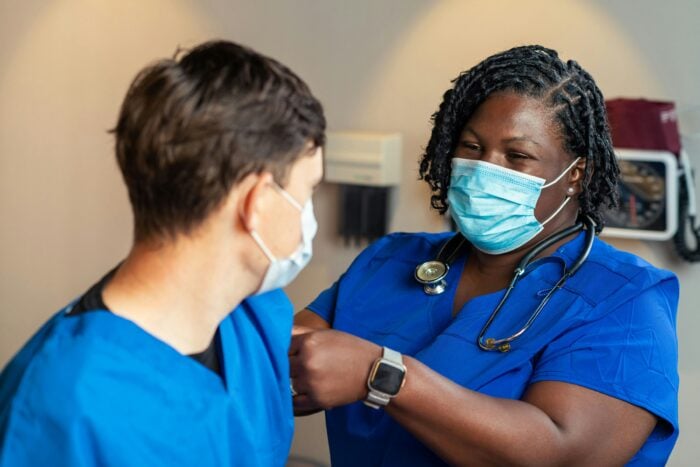


If you want to start a healthcare career quickly, becoming a medical assistant in California is one of the most accessible and high-demand options. California employs over 110,000 medical assistants, more than any other state, according to the BLS. Medical assistants (MAs) support clinics, hospitals, and outpatient centers by performing a mix of clinical and administrative tasks — helping providers deliver efficient, high-quality care.
This guide provides an overview of how to become a medical assistant in California and breaks down everything you need to know — training, certification, requirements, duties, costs, salary, and California-specific regulations.
Table of Contents
What Is a Medical Assistant in California?
A medical assistant is a trained healthcare professional who supports physicians, nurses, nurse practitioners (NPs), physician assistants (PAs), and clinic managers by handling both clinical and administrative tasks. In California, medical assistants work under direct or general supervision depending on the task.
How medical assistants differ from other healthcare roles
- Medical assistants vs. CNAs: CNAs typically work in long-term care settings and focus on daily living tasks; MAs work mostly in outpatient settings and handle clinical + administrative duties.
- MAs vs. nurses (LVNs/RNs): Nurses have licensure, can assess patients, and perform higher-risk clinical tasks. MAs cannot diagnose, independently assess, or operate without supervision.
- MAs vs. administrative medical office staff: MAs bridge both worlds—clinical and administrative—making them more versatile.
Job growth outlook
Nationally, the role is projected to grow 12% from 2024–2034, much faster than average. California employs more medical assistants than any other U.S. state — over 110,000 as of the most recent OEWS data. Statewide—and especially in populous metro regions—demand remains high.
Primary Duties & California Scope of Practice
Medical assistants in California perform a wide variety of tasks. These typically fall into two categories:
Clinical Duties
- Taking and recording vital signs
- Preparing exam rooms and sterilizing instruments
- Assisting physicians with minor procedures
- Collecting lab specimens and performing waived tests
- Administering medications when permitted
- Documenting patient histories
- Performing EKGs
Administrative Duties
- Scheduling appointments
- Managing patient check-ins
- Updating electronic health records (EHR)
- Verifying insurance and handling billing paperwork
- Communicating with patients, labs, and pharmacies
California Medical Assistant Scope-of-Practice Rules
California regulates what medical assistants can and cannot do under Business & Professions Code §2069-§2071 and Medical Board of California guidelines.
Supervision Requirements
- Direct supervision: Physician, PA, NP, or RN is physically present in the facility while MA performs clinical tasks.
- General supervision: Licensed provider is available by phone; applies mainly to administrative tasks.
Training Requirements for Clinical Tasks
To perform tasks like injections, blood draws, and skin tests, MAs must receive documented training from a licensed provider, including:
- The method of administration
- Side effects & complications
- Infection control
- Emergency procedures
This training must be signed and kept in personnel files.
What Medical Assistants Can vs. Cannot Do in California
| Can Do | Cannot Do |
| Take vital signs | Independently assess or diagnose |
| Administer injections (after documented training + direct supervision) | Administer anesthesia |
| Perform EKGs, collect specimens | Start or discontinue IVs |
| Assist with minor procedures | Perform triage |
| Perform skin tests (PPD, allergy tests) | Interpret test results |
| Remove sutures / staples (with supervision) | Work as LVN/RN without appropriate license |
| Perform venipuncture (after training) | Make medication dosage decisions |
Source: Medical Board of California
How Long Does It Take to Become a Medical Assistant in California?
Most people become MAs in 4–12 months, depending on program type and pace.
Program Type Comparison
| Program Type | Duration | Best For | Notes |
| Certificate / Diploma | 4–9 months | Fast entry into workforce | Most common path; includes externship |
| One-Year Programs | 10–12 months | Students wanting more in-depth training | Often include more clinical hours |
| Associate Degree (A.S.) | 18–24 months | Students seeking long-term advancement | More classroom time; higher cost |
Accelerated programs (like 4-month formats) allow learners to finish quickly while continuing to work or care for family. The Springboard Certified Medical Assistant Program prepares students to jump into their clinical externship within just 4 months.
Do Medical Assistants Need to Be Certified in California?
Short answer: No — but certification is strongly recommended.
California is one of the few states that does not require certification to work as a medical assistant. However, most California healthcare employers prefer or require certified candidates because:
- It demonstrates verified competency
- It reduces employer training burden
- It improves patient safety
- It aligns with reimbursement and compliance requirements
The Medical Board of California explicitly allows uncertified MAs — but certification significantly improves employability. The Springboard Certified Medical Assistant Program prepares students to sit for the Certified Clinical Medical Assistant (CCMA) exam.
Read Next: California Medical Assistant Requirements: Certifications, Training, and Laws (2026 Guide)
How to Become a Certified Medical Assistant in California (Step-by-Step)
To become a certified medical assistant in California, follow these steps:
Step 1: Complete a Medical Assistant Program That Prepares You to Sit for a Certification Exam
Becoming certified demonstrates that you meet the knowledge and clinical requirements needed for California’s training expectations.
Programs may be:
- Fully online
- Hybrid (online + in-person labs)
- In-person at trade schools or community colleges
Step 2: Register for Your Preferred Certification Exam
Here are the four most recognized certifications in California:
| Certification | Issuing Body | Exam Cost | Eligibility Requirements | Recognition in CA |
| CCMA | NHA | ~$115 | Training or 1 year experience | Very common |
| CMA | AAMA | ~$125 | Graduate of CAAHEP/ABHES program | Very high |
| RMA | AMT | ~$120 | Accredited program or work experience | High |
| NCMA | NCCT | ~$110 | Training, military, or experience | Growing |
Note that the Springboard Certified Medical Assistant Program, designed in partnership with the NHA, includes an exam voucher covering the cost of the CCMA certification exam.
What you need to register:
- Proof of program completion
- Official transcripts
- Government ID
- Exam fee payment
- Sometimes: externship verification
Step 3: Study and Prepare for the Exam
Success in certification exams requires a blend of clinical knowledge, administrative skills, and California-specific regulation understanding.
Study Tips:
- Use official exam books and online study portals
- Take timed practice exams
- Review high-yield topics:
- Anatomy & physiology
- Infection control
- Pharmacology basics
- EHR & billing
- CA delegation laws
- Create a 4–6 week study plan
The Springboard Certified Medical Assistant Program follows the CCMA test plan layout, covering foundational knowledge and basic science, anatomy and physiology, clinical patient care, and administrative assisting. Curriculum also includes dedicated weeks of studying for the exam, including personalized study guides and practice exams.
Step 4: Pass the Exam and Maintain Your Certification
After passing:
- You’ll receive your credential and digital badge
- Employers may verify your certification online
- You must renew based on certifier rules (every 2–5 years)
Maintaining certification typically requires:
- Continuing education units (CEUs)
- Renewal fees
- Staying up-to-date on CA regulations
To maintain the NHA Certified Clinical Medical Assist (CCMA) certification, you must renew every two years by earning 10 continuing education credits, paying the renewal fee, and submitting the renewal request through your NHA account online. Keep in mind that employers may cover the costs of maintaining your certification.
California Medical Assistant Requirements
High level, to work as an MA in California, you must meet these baseline criteria:
- 18+ years old (most employers)
- High school diploma or GED
- Completion of a medical assistant training program, like Springboard’s Certified Medical Assistant Program (highly preferred)
- Documented competency for injections/venipuncture (if performing these tasks)
- Understand CA supervision rules
- Pass background screening (varies by employer)
- Maintain CPR/BLS certification (common requirement)
Some clinics may offer on-the-job training, but completing a program + certification significantly increases your job prospects. California does not license medical assistants, but their are California-specific training requirements, certification pathways, scope-of-practice rules, and legal regulations.
Where Medical Assistants Work in California
California has one of the largest and most diverse healthcare ecosystems in the country.
Common work settings:
- Primary care clinics
- Specialty clinics (cardiology, dermatology, GI, OB/GYN, pediatrics)
- Urgent care centers
- Outpatient surgical centers
- Hospitals (outpatient departments)
- Telehealth support teams
- Medical labs
Urban vs. Rural Breakdown
- Urban areas: LA, San Diego, San Jose, San Francisco — highest salaries and most job openings
- Rural areas: Greater Central Valley, far north counties — fewer applicants, increasing demand
Medical Assistant Salary in California (2026 Update)
California medical assistant salaries are some of the highest in the United States, with California also employing the most medical assistants in the country.
Average salary in California:
$29.18/hr (~$48,050 annually) per the BLS.
Metro Breakdown Table
| Metro Area | Average Hourly Wage | Annual Salary |
| Sacramento–Roseville | ~$30.08 | ~$62,570 |
| San Jose–Sunnyvale | ~$29.95 | ~$62,290 |
| San Francisco–Oakland | ~$28.80 | ~$59,910 |
| San Diego–Carlsbad | ~$22.97 | ~$47,780 |
| Los Angeles–Long Beach | ~$22.11 | ~$46,000 |
| Fresno | ~$21.49 | ~$44,700 |
These figures make California an especially attractive state for entering the healthcare field.
Read Next: California Medical Assistant Salary Report: 10 Best-Paying Locations
How Much Does Medical Assistant Training Cost?
Medical assistant (MA) training programs in the U.S. vary significantly in cost depending on program length, institution type, and whether you pursue a certificate or a degree.
Typical cost ranges:
- Certificate or Diploma: Most certificate-level MA programs, typically 4–12 months long, cost between $2,000 and $10,000. Depending on discounts being offered, the Springboard Certified Medical Assistant Program usually runs about $2,500 and can be completed in 4 months.
- One-Year Programs: Commonly offered through private colleges and technical schools, these programs tend to range from $10,000–$18,000.
- Associate Degree: Generally taking about two years, associates degrees offered by community colleges and private institutions could range between $15,000–$30,000.
Financial aid options:
- Pell Grants
- State grants (Cal Grants, if degree-granting)
- Scholarships
- Payment plans
- Workforce funding programs
- Employer tuition assistance (in some health systems)
Training cost vs salary (ROI)
| Program Type | Typical Cost | Avg CA Salary | Monthly Salary | Estimated Break-Even |
| Certificate | ~$5,000 | $48,050 | ~$4,004 | 1-2 months |
| One-Year | ~$12,000 | $48,050 | ~$4,004 | 3 months |
| Associate | ~$20,000 | $48,050 | ~$4,004 | 5 months |
Tips for Choosing the Right Medical Assistant Program
1. Determine if the Program Prepares You for Certification
Accreditation and program structure determines whether you’re eligible for certification exams.
Look for programs that allow you to sit for one of the following certification exams:
- CMA
- RMA
- CCMA
- NCMA
2. Review Curriculum + Hands-On Training
A high-quality program includes:
- Clinical labs
- Phlebotomy and injections training
- EHR training
- Administrative coursework
- A structured externship
3. Evaluate Program Length & Flexibility
Ask:
- Can you study while working full-time?
- Does the program offer part-time or accelerated options?
- Are labs required in person?
4. Compare Tuition & Financial Aid Options
Consider:
- Total cost
- Hidden fees (scrubs, exam fees, immunizations, lab kits)
- Payment plan availability
- Externship placement support (big differentiator)
California State Medical Assistant Certification Options
Below is a deeper comparison of the four major certification pathways:
| Certification | Issuing Body | Eligibility | Cost | Renewal | Source |
| CMA (AAMA) | American Association of Medical Assistants | Graduate of CAAHEP or ABHES accredited MA program | $125 | Every 5 years | https://www.aama-ntl.org/certification/eligibility |
| RMA (AMT) | American Medical Technologists | Multiple pathways including accredited MA program, military training, or 3 years’ experience | $150 | Every 3 years | https://americanmedtech.org/medical-assistant |
| CCMA (NHA) | National Healthcareer Association | MA training program or 1 year of experience | $165 | Every 2 years | https://www.nhanow.com/certification/nha-certifications/certified-clinical-medical-assistant-(ccma) |
| NCMA (NCCT) | National Center for Competency Testing | MA training program, military experience, or 1 year experience | $119 | Annual renewal | https://www.ncctinc.com/certifications/ma |
These certifications are all accepted by California employers.
Your Next Step to Launch Your Medical Assistant Career in California
Becoming a medical assistant in California opens the door to a stable, flexible, high-impact career in healthcare — without spending years in school. By completing training, earning certification, and understanding California-specific requirements, you’ll be ready to step into roles across clinics, hospitals, labs, and urgent care centers.
If you’re ready to start your medical assistant career in as little as four months, you can explore a flexible, online-friendly program that includes personalized support and externship placement assistance.
👉 Ready to take the next step? Apply now to begin your medical assistant training.
Explore the Certified Medical Assistant Program, your path to a healthcare career in just 4 months.
FAQs About Becoming a Medical Assistant in California
Can I study online while working full-time?
Yes. Many programs offer flexible online or hybrid formats designed for working adults. You can complete coursework while maintaining employment.
Do medical assistants need to be certified in California?
No — certification isn’t legally required, but most employers strongly prefer it. Certification improves job prospects and pay. There are also a number of on-the-job duties that require training to be sufficient.
Can medical assistants give injections in California?
Yes, but only after receiving documented training and under direct supervision of a physician, NP, PA, or RN.
How do I find externship opportunities?
Quality programs arrange externship placements for you so you get hands-on clinical practice without searching independently. The Springboard Certified Medical Assistant Program, for example, supports externship placement at a clinical partner located close to students.
What if I already have healthcare experience?
Experience helps, but certification eligibility requirements remain the same.
How much do medical assistants earn in California?
Average pay is about $29.18/hr or about $48,050 annually, per the BLS, with higher salaries in Los Angeles, San Francisco, San Jose, and coastal regions.
How many externship hours do I need?
Most programs include 120–200 hours of supervised clinical practice — essential for certification and job readiness.
Can I become a medical assistant without schooling?
Technically yes, but employers rarely hire uncertified, untrained candidates. Completing a program is the most reliable path.